Discover how AI is reshaping the translation industry, its benefits and limitations, and why human expertise remains essential for high-quality translations.
How Artificial Intelligence is Transforming Global Communication
In today’s interconnected world, communication across languages is no longer a luxury-it is a necessity. Businesses expand globally, digital content spreads instantly, and international collaboration happens every second. At the center of this transformation lies the translation industry, a field that is rapidly evolving thanks to Artificial Intelligence (AI).
But is AI replacing human translators? Or is it reshaping the industry in a more powerful way?
This article explores how AI is transforming translation, the opportunities it creates, and why human expertise remains essential in the future of global communication.
1. The Rise of AI in the Translation Industry
Artificial Intelligence has revolutionized how translations are performed. Tools like Google Translate, DeepL, and AI-powered CAT (Computer-Assisted Translation) tools can now process vast amounts of text in seconds.
Key advancements include:
- Neural Machine Translation (NMT): Produces more natural and context-aware translations.
- Speech-to-text and real-time translation: Enables live multilingual communication.
- AI-assisted localization: Helps adapt content for specific markets quickly.
AI systems are trained on massive datasets, allowing them to recognize patterns and deliver increasingly accurate results. This has significantly reduced translation time and cost, making multilingual content more accessible than ever before.

2. Benefits of AI in Translation
AI has brought undeniable advantages to the translation industry, especially for businesses operating at scale.
Speed and Efficiency
AI can translate thousands of words in seconds, making it ideal for large volumes of content such as:
- Product descriptions
- Technical manuals
- User-generated content
Cost Reduction
Automated translation reduces the need for manual labor in repetitive tasks, lowering overall costs.
Consistency
AI tools maintain consistent terminology across documents, which is crucial for branding and technical accuracy.
Accessibility
Small businesses can now access translation tools that were once only available to large corporations.
3. Limitations of AI Translation
Despite its advantages, AI translation is far from perfect.
Lack of Cultural Understanding
AI struggles with:
- Idioms
- Cultural nuances
- Humor and tone
For example, a marketing slogan may be translated correctly in grammar but fail completely in impact.
Context Issues
AI may misinterpret:
- Industry-specific terminology
- Ambiguous phrases
- Complex sentence structures
Risk in Sensitive Content
Legal, medical, and financial translations require absolute accuracy. A small error can lead to serious consequences.
4. The Irreplaceable Role of Human Translators
While AI can handle speed and volume, human translators bring something AI cannot: understanding.
Cultural Intelligence
Human translators adapt content to fit:
- Local culture
- Audience expectations
- Emotional tone
Creativity
In fields like marketing and branding, translation is not just about words – it’s about impact.
Critical Thinking
Humans can:
- Interpret meaning beyond text
- Detect errors
- Ensure context accuracy
Quality Assurance
Professional translators review and refine AI-generated content to ensure it meets high standards.
5. Human + AI: The New Translation Model
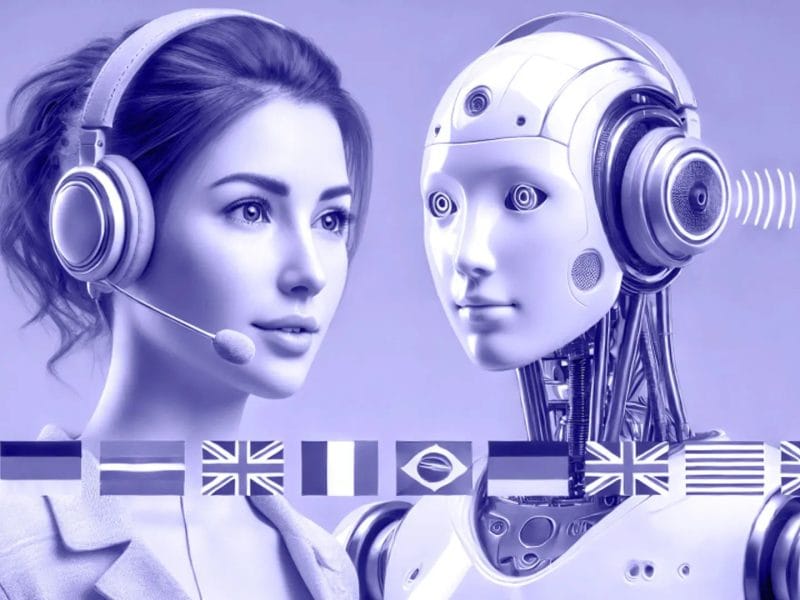
The future of translation is not AI vs. humans – it is AI + humans.
This hybrid approach is already becoming the industry standard.
How it works:
- AI generates a draft translation
- Human translators edit and refine (post-editing)
- Final content is reviewed for accuracy and style
Benefits of this model:
- Faster turnaround time
- Lower costs compared to full manual translation
- High-quality output
This collaboration allows businesses to scale globally without compromising quality.

6. The Impact on Translation Careers
AI is changing the skill set required for translators.
New skills in demand:
- Post-editing AI translations
- Using CAT tools and translation software
- Understanding AI workflows
- Localization expertise
Rather than replacing jobs, AI is creating new roles, such as:
- Language technology specialists
- AI training data reviewers
- Localization project managers
7. Opportunities for Businesses
Companies that embrace AI-powered translation gain a competitive advantage.
Faster Market Expansion
Businesses can launch products in multiple languages quickly.
Improved Customer Experience
Localized content helps connect with customers on a deeper level.
Scalability
AI enables companies to handle increasing content demands efficiently.
However, relying solely on AI can damage brand reputation if translations are inaccurate or culturally inappropriate.
8. Why Professional Translation Services Still Matter
Even in the AI era, professional translation agencies remain essential.
Key reasons:
- Expertise in specialized fields (legal, medical, technical)
- Quality control and proofreading
- Cultural adaptation and localization
- Confidentiality and data security
A reliable translation partner ensures that your message is not just translated-but communicated effectively.
9. The Future of the Translation Industry
Looking ahead, the translation industry will continue to evolve alongside technology.
Trends to watch:
- Real-time multilingual communication
- AI-powered voice translation
- Integration of AR/VR in interpreting
- Hyper-personalized localization
In the next 10 years, translation will become even more seamless, but human expertise will remain at the core of meaningful communication.

Artificial Intelligence is transforming the translation industry in powerful ways – making it faster, more accessible, and more efficient. However, AI alone cannot replace the depth of understanding, creativity, and cultural sensitivity that human translators provide.
The future belongs to those who embrace both technology and human expertise.
At the end of the day, translation is not just about converting words – it’s about connecting people, cultures, and ideas across the world.