Translating millions of e-commerce product
records within a tight deadline requires
more than linguistic expertise.
It demands scalable workflows, careful
terminology management and the ability
to handle content mixed with technical code.
Interprotrans undertook a large-scale
localization assignment for Lazada,
involving more than two million product
SKUs and a demanding project timeline
of approximately one month.
Lazada is a leading e-commerce platform
serving consumers and businesses across
Southeast Asia. Its digital marketplace
brings together a wide variety of
products, sellers and customer segments.
Large online marketplaces depend on
accurate and consistent product information
to help shoppers understand product
specifications, compare options and
make purchasing decisions.
When a marketplace operates across
languages and markets, localization
becomes an important part of maintaining
a clear and accessible customer experience.
One of the most demanding aspects of
the Lazada assignment was its scale.
The project involved product-related
content covering more than two million
stock keeping units, commonly known
as SKUs.
Product catalog localization at this
scale presents challenges that differ
significantly from conventional
document translation.
A single product record may contain
product names, specifications,
descriptions, variations, attributes
and formatting elements.
Consistency across these fields is
essential for maintaining usable
marketplace content.
Completing a high-volume localization
project under an approximately
one-month deadline requires careful
planning and efficient coordination.
Unlike a standard translation project,
large-scale e-commerce localization
must account for extensive repetition,
variations in product terminology
and differences in data structure.
These requirements demonstrate why
enterprise-scale localization needs
a structured approach combining
linguistic quality with technical
content handling.
A particularly complex characteristic
of the Lazada project was the presence
of source-code elements interspersed
throughout product-related text.
In digital commerce systems, product
content may contain HTML tags,
formatting instructions, placeholders,
special characters or structured
data fields.
These elements must be distinguished
from text intended for translation.
Incorrectly modifying technical
components can affect how information
is displayed or processed.
In this illustrative example,
customer-facing descriptions are
translatable, while HTML structure,
attribute names and SKU identifiers
should generally remain unchanged.
Proper separation of linguistic
content and technical syntax is
essential for reducing errors
during localization.
E-commerce translation is not limited
to replacing words from one language
with another. Product content must
remain understandable, consistent
and appropriate for its target market.
Large catalogs may contain thousands
of repeated terms and closely related
product variations. A consistent
approach helps avoid conflicting
terminology and confusing descriptions.
Businesses seeking similar support
can explore
professional e-commerce translation
and specialized document services
provided by Interprotrans.
Projects involving millions of
product records benefit from
technology-assisted workflows,
consistent terminology management
and systematic quality control.
Depending on project requirements,
suitable workflows may involve
content segmentation, identification
of non-translatable elements,
terminology reference materials
and validation of output structures.
These methods help translation teams
address the challenges of high-volume
multilingual content while maintaining
attention to accuracy and consistency.
Through its
enterprise translation and localization services
,
Interprotrans supports businesses
managing complex language requirements.
The localization needs of digital
commerce companies extend beyond
individual product descriptions.
International marketplaces and
online retailers may require
multilingual product catalogs,
website localization, technical
content translation and ongoing
language support.
Translation of product titles,
descriptions, specifications
and category information.
Adaptation of digital content
for multilingual websites
and online platforms.
Language processing for
content containing structured
data and technical elements.
Translation support for
businesses managing substantial
volumes of multilingual content.
Interprotrans also offers
international translation
and localization solutions
for organizations with diverse
language and technical requirements.
The Lazada project highlights
the challenges associated with
translating exceptionally large
volumes of e-commerce content
within a compressed timeframe.
With more than two million SKUs,
an approximately one-month
project window and source-code
elements embedded throughout
the content, the assignment
required careful attention
to both language and
technical structure.
Interprotrans continues to
develop its capabilities in
professional translation,
digital content localization
and multilingual business
communication.
INTERPROTRANS — PROFESSIONAL
LANGUAGE SOLUTIONS FOR
GLOBAL DIGITAL BUSINESSES.
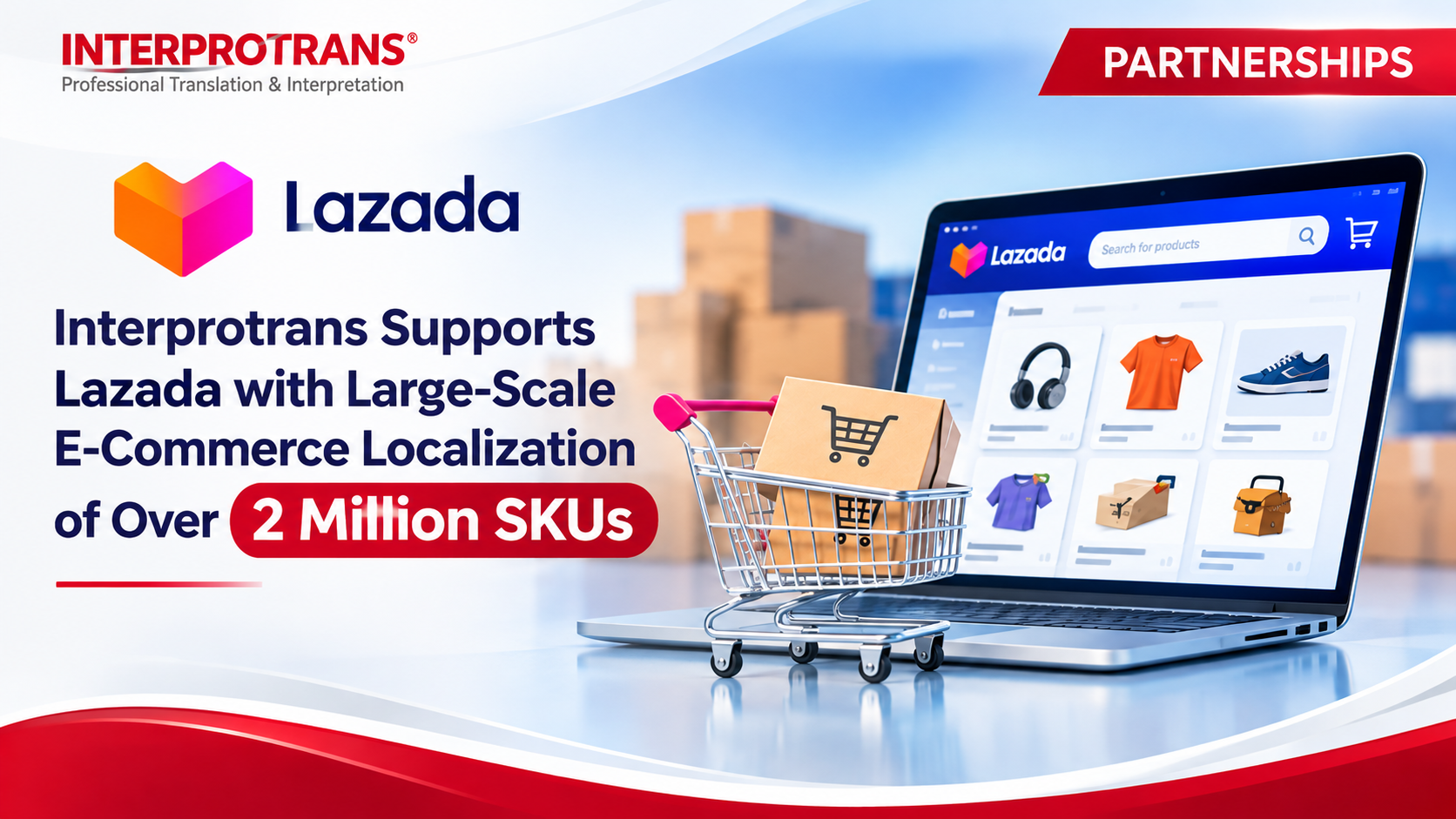
Interprotrans Supports Lazada with
Large-Scale E-Commerce Localization
of Over 2 Million Product SKUs

Lazada: A Major E-Commerce Platform
in Southeast Asia
A High-Volume Localization Project:
More Than 2 Million SKUs
Translating Product Content
Within an Extremely Tight Deadline
Key Operational Challenges
The Technical Challenge:
Source Code Embedded in Product Content
Illustrative Example of Mixed Content
Why E-Commerce Localization
Requires Specialized Expertise
Technology and Translation
Workflow Management

Comprehensive Language Solutions
for Digital Commerce Businesses
Product Catalog Localization
Website Localization
Technical Content Translation
Large-Scale Language Projects
Interprotrans: Supporting
Enterprise-Scale Localization
2M+
Product SKUs in Project Scope
~1 Month
Demanding Delivery Window
Code + Text
Mixed Technical Content
Project Challenge:
The assignment combined exceptionally
high content volume, a compressed
delivery schedule and technical
source-code elements embedded within
translatable product information.
<div class=”product-description”>
<h3>Product Name</h3>
<p>Lightweight and breathable material</p>
<span data-sku=”SKU-001″>Available sizes</span>
</div>