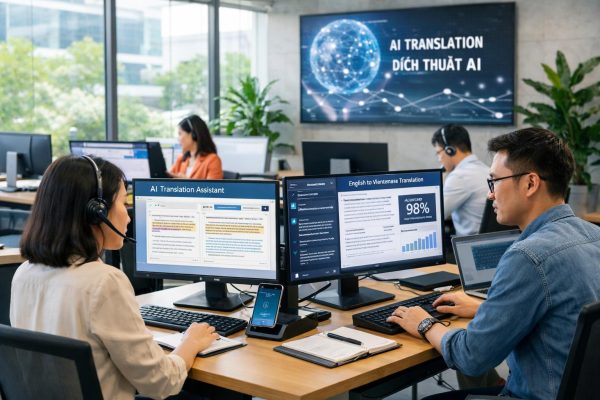
Introduction to AI Innovations in the Translation Industry

The translation sector in 2026 is undergoing rapid transformation, driven by groundbreaking advances in Artificial Intelligence (AI) and machine learning technologies. These developments are reshaping how translation services are delivered, enhancing productivity and quality while posing new challenges for human translators. This article examines current AI trends in translation, the impact on professional linguists, and the emerging opportunities for translation companies in Vietnam, with a focus on Interprotrans’ pioneering integration of AI in professional language services.
Cutting-Edge AI Technologies in Translation
Recent years have witnessed significant improvements in AI translation workflows. Neural Machine Translation (NMT) models, powered by deep learning architectures, now offer more fluent, context-aware translations across diverse language pairs. Innovations include:
- Adaptive AI Systems: These dynamically learn from user feedback to improve domain-specific accuracy, reducing post-editing time.
- Multimodal Translation: Incorporating voice, video, and text inputs, enabling seamless localization in multimedia content.
- Human-in-the-Loop AI: Combining AI’s speed with human expertise to maintain cultural nuance and contextual appropriateness, as highlighted in the Vistatec and Slator report on trusted AI and human quality governance.
These technologies are increasingly integrated into translation management platforms, enabling real-time collaboration and automated quality assurance.
AI-Driven Pricing and Quality Models
According to the wxrks CEO interview, AI localization tools are influencing traditional pricing structures. Companies are adopting hybrid models that account for AI efficiency gains alongside expert human review, ensuring competitive pricing without compromising quality.
Impact on Translators and Interpreters
The rise of AI has created both opportunities and challenges for professional linguists. While AI accelerates routine translation tasks, there remains a critical need for human oversight, especially for complex, creative, or culturally sensitive content. Key impacts include:
- Shift in Skill Requirements: Translators increasingly require proficiency with AI-assisted tools and post-editing skills.
- Focus on Higher-Value Work: Human experts concentrate on nuanced interpretation, localization strategy, and quality control.
- Collaboration Enhancement: AI enables linguists to handle larger volumes efficiently, fostering closer teamwork with technology.
This evolving role underscores the importance of continuous professional development to stay competitive.
Growth Opportunities for Vietnamese Translation Companies
Vietnam’s translation market is poised for significant expansion due to rising demand in sectors such as technology, manufacturing, and e-commerce. AI adoption presents strategic advantages for Vietnamese companies, including:
- Scalability: AI tools help manage increasing workloads with limited resource growth.
- Quality Consistency: Automated quality checks reduce errors and improve client satisfaction.
- Competitive Differentiation: Early AI integration positions companies as innovative market leaders.
Interprotrans exemplifies this trend by actively incorporating AI technologies to enhance translation accuracy and workflow efficiency while maintaining human expertise at the core of its services. Their approach ensures clients receive professional, culturally precise translations enhanced by AI capabilities.
Interprotrans’ Role in AI-Enhanced Translation
As a leading language service provider in Vietnam, Interprotrans has embraced AI tools to support professional translators and interpreters. By leveraging AI for tasks such as terminology management, initial draft translation, and quality assurance, Interprotrans optimizes project turnaround and cost-effectiveness. This integration aligns with global best practices and helps meet the evolving expectations of international clients.
Conclusion
The translation industry in 2026 is characterized by a dynamic interplay between AI innovations and human expertise. For Vietnamese translation companies, embracing AI technologies offers a pathway to enhanced service quality, operational efficiency, and market competitiveness. Interprotrans’ proactive adoption of AI reflects a forward-thinking strategy that benefits translators, clients, and the broader language services ecosystem in Vietnam.
For further insights and professional translation solutions, visit Interprotrans and explore resources at Dich Thuat Nhanh and TranslationStudy.