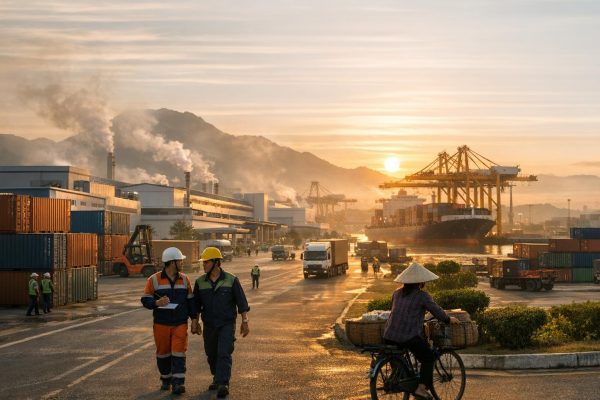
Vietnam’s Rising Investment Profile: Promise Meets Complexity
In 2026, Vietnam continues to capture the attention of foreign investors as one of Asia’s fastest-growing economies. Robust GDP growth, a youthful labor force, and strategic location in Southeast Asia bolster its appeal. However, beneath these promising fundamentals lies a complex web of political, regulatory, and market risks that demand careful navigation. For foreign companies contemplating entry or expansion, understanding this duality is essential to crafting effective strategic plans and mitigating potential pitfalls.
Growth Drivers Fueling Vietnam’s Investment Appeal
Vietnam’s economic trajectory remains impressive, with the World Bank forecasting a GDP growth rate hovering around 6-7% annually, supported by strong domestic consumption and export diversification. Key sectors such as electronics manufacturing, renewable energy, and logistics are rapidly expanding, driven by improving infrastructure and government incentives.

One critical advantage is Vietnam’s integration into global value chains, notably through free trade agreements like the Comprehensive and Progressive Agreement for Trans-Pacific Partnership (CPTPP) and the EU-Vietnam Free Trade Agreement (EVFTA). These accords reduce tariffs and open markets, making Vietnam an attractive hub for export-oriented manufacturing.
Moreover, Vietnam’s demographic dividend—a median age of approximately 32 years—provides a dynamic labor pool. This youthful workforce is increasingly skilled, aided by government investments in education and vocational training, aligning talent supply with industry needs.
Political and Regulatory Risks: Navigating an Evolving Landscape
Despite favorable growth indicators, Vietnam’s political environment presents inherent risks. The country’s one-party system ensures policy continuity but can also lead to opaque governance structures. Foreign investors often face challenges related to bureaucratic red tape, inconsistent enforcement of regulations, and sudden policy shifts.
Regulatory frameworks, particularly around foreign ownership and land leasing, remain complex. While recent reforms aim to liberalize sectors and streamline licensing procedures, discrepancies between central government guidelines and local implementation persist. For instance, provincial authorities may impose additional requirements or delays, complicating project timelines.
Corruption, though addressed by government anti-corruption campaigns, still affects business operations. Transparent due diligence and local partnerships can mitigate such risks but require time and resources.
Market Risks and Operational Challenges
Vietnam’s rapid urbanization and rising consumer demand open significant market opportunities, especially in retail, technology, and services. However, market risks include intense competition from both domestic firms and other foreign entrants, fluctuating currency volatility, and supply chain vulnerabilities.
Infrastructure, while improving, remains unevenly developed. Congestion in key hubs like Ho Chi Minh City and Hanoi can increase logistics costs and affect delivery efficiency. Energy shortages occasionally disrupt production in industrial zones, underscoring the need to assess location-specific risks carefully.
Furthermore, legal protections for intellectual property (IP) are evolving but not yet fully mature. Foreign companies must proactively safeguard IP rights through contracts and local registrations to avoid infringement issues.
Case Study: Electronics Manufacturing Sector
The electronics manufacturing sector exemplifies Vietnam’s investment potential and challenges. Major global brands have expanded production facilities, attracted by competitive labor costs and trade agreements. However, companies report navigating complex local labor regulations and occasional supply chain disruptions, particularly in component sourcing.
Successful entrants often adopt a dual strategy: leveraging local language solutions in Vietnam to bridge communication gaps and employing professional translation services during contract negotiations and compliance audits to reduce misunderstandings and legal risks.
Institutional and Social Factors: The Underexplored Dimensions of Investment Risk
While political, regulatory, and market risks receive considerable attention, a critical but underexplored dimension influencing foreign investment success in Vietnam lies in the institutional and social fabric of the country. These factors—encompassing governance quality, social trust, labor relations, and community engagement—shape the operational environment in profound ways that directly affect project viability and long-term sustainability.
Governance Quality and Institutional Capacity
Vietnam’s rapid economic transformation has outpaced the development of institutional capacities in some areas. Although the central government has demonstrated commitment to reform, local government units vary significantly in administrative competence, transparency, and responsiveness. This disparity can lead to unpredictable delays, inconsistent enforcement of regulations, and challenges in obtaining permits or resolving disputes.
Moreover, the centralized political system, while providing stability, sometimes limits local autonomy and innovation, affecting how policies are implemented on the ground. Foreign investors must therefore not only engage with central authorities but also cultivate relationships with provincial and municipal officials to navigate these institutional nuances effectively.
Social Trust and Business Environment
Social trust—both between businesses and between businesses and government institutions—is a vital yet intangible asset. In Vietnam, varying degrees of trust influence contract enforcement, partnership reliability, and dispute resolution mechanisms. The prevalence of informal business practices and reliance on personal networks (“quan hệ”) can create barriers for foreign companies accustomed to formalized, transparent processes.
Understanding and respecting local business customs and social expectations can facilitate smoother interactions and reduce friction. Conversely, failure to appreciate these social dynamics may result in misunderstandings, reputational damage, or operational setbacks.
Labor Relations and Workforce Dynamics
Vietnam’s youthful labor force is a significant asset, but labor relations present complex challenges. While labor laws have evolved to provide protections and define employer-employee rights, enforcement can be uneven. Strikes and labor disputes, although less frequent than in some neighboring countries, still occur, particularly in sectors with intense production pressures such as manufacturing.
Foreign investors must invest in proactive human resource strategies that go beyond compliance. This includes fostering open communication channels with workers, investing in training and career development, and understanding local labor market expectations. Such approaches not only mitigate risks of labor unrest but also enhance productivity and employee loyalty.
Community Engagement and Corporate Social Responsibility (CSR)
As Vietnam’s economy grows, local communities are increasingly aware of and sensitive to the social and environmental impacts of foreign investment projects. Community opposition can emerge around issues such as land acquisition, environmental degradation, or perceived inequities in economic benefits.
Effective community engagement strategies are therefore essential. Foreign companies that actively involve local stakeholders, transparently communicate project benefits and impacts, and contribute to community development initiatives can build goodwill and social license to operate. This not only reduces risks of protests or delays but also strengthens the company’s brand and local integration.
Real-World Implications for Investors
Neglecting these institutional and social dimensions can lead to tangible negative outcomes. For example, a manufacturing plant may face unanticipated delays if local authorities are uncooperative or if community opposition arises. Labor disputes can disrupt production schedules, increase costs, and harm reputations. Conversely, firms that invest in understanding and engaging these factors often experience smoother project execution, enhanced local partnerships, and long-term operational resilience.
Practical Trade-Offs and Strategic Choices
Addressing institutional and social risks requires resources—time, financial investment, and organizational commitment. Smaller firms may find it challenging to allocate sufficient capacity for these efforts, while larger corporations often have dedicated teams for stakeholder engagement and government relations.
Strategically, investors must balance the costs of proactive engagement against the risks and costs of potential disruptions. Early-stage feasibility studies should incorporate social impact assessments and institutional analyses. Moreover, partnering with local firms or consultants who possess deep contextual knowledge can enhance effectiveness and credibility.
Future Opportunities Through Institutional Strengthening
Vietnam’s government recognizes the importance of strengthening institutional frameworks and social cohesion to sustain economic growth. Initiatives aimed at improving transparency, enhancing public service delivery, and promoting corporate social responsibility are gaining momentum.
Foreign investors who align with these evolving priorities and contribute to capacity-building—such as through technology transfer, workforce development, and CSR programs—can position themselves as preferred partners. This alignment not only mitigates risks but also opens avenues for collaboration in emerging sectors like green energy, digital economy, and sustainable agriculture.
Furthermore, as Vietnam integrates more deeply into international trade systems and adopts global standards, institutional reforms are likely to accelerate. Investors prepared to engage constructively with these changes will gain competitive advantages in compliance, market access, and stakeholder relations.
Integrating Institutional and Social Risk into Strategic Investment Frameworks
Despite growing awareness of institutional and social factors, many foreign investors still treat these dimensions as peripheral rather than integral to their risk management frameworks. This oversight can lead to suboptimal decision-making and missed opportunities for creating sustainable competitive advantages in Vietnam’s complex environment.
To truly harness Vietnam’s potential, investors must embed institutional and social risk assessments into every stage of the investment lifecycle—from initial market entry feasibility studies to ongoing operational management and exit strategies. This involves developing tailored metrics and indicators that capture governance quality, community sentiment, labor relations climate, and social trust levels.
For example, incorporating stakeholder mapping and social network analysis can reveal key influencers and informal power structures within local communities and government entities. This intelligence enables more precise targeting of engagement efforts and anticipates potential friction points before they escalate.
Additionally, integrating regular social impact monitoring and feedback mechanisms allows companies to dynamically adjust their CSR initiatives and operational practices in response to evolving community expectations and institutional shifts. Such adaptive management not only mitigates risks but also fosters innovation by aligning business models with local needs and values.
From a practical standpoint, investors should consider multidisciplinary teams combining expertise in political economy, sociology, labor relations, and environmental science alongside traditional financial and legal analysis. Building these capabilities internally or through strategic partnerships enhances the depth and relevance of institutional and social risk management.
Ultimately, viewing institutional and social factors as strategic assets rather than mere compliance obligations transforms risk into opportunity. Companies that pioneer this integrated approach in Vietnam can differentiate themselves as responsible, resilient, and locally embedded actors—qualities increasingly valued by consumers, governments, and global capital markets alike.
Strategic Implications for Foreign Investors
To capitalize on Vietnam’s growth while managing risks, investors should adopt a comprehensive risk management framework:
- Thorough Due Diligence: Beyond financial metrics, assess local political dynamics, regulatory environments, and partner reputations.
- Engage Local Expertise: Collaborate with professional translation services and legal consultants to navigate language barriers and regulatory complexities effectively.
- Flexible Operational Models: Consider joint ventures or strategic alliances that provide local market insight and risk sharing.
- Continuous Monitoring: Maintain active oversight of policy changes and market conditions to adapt strategies promptly.
- Institutional and Social Risk Assessment: Incorporate analyses of governance quality, social trust, labor relations, and community dynamics into investment planning.
- Proactive Stakeholder Engagement: Develop strategies for transparent communication and community involvement to build social license and mitigate opposition.
- Human Capital Investment: Prioritize workforce development and labor relations management to enhance productivity and reduce operational disruptions.
Role of Language and Communication in Risk Mitigation
Accurate communication is often underestimated in its role for successful investment. Employing professional translator training courses ensures that internal teams and local partners share a clear understanding of contractual terms, compliance requirements, and cultural nuances. This minimizes misinterpretations that could escalate into costly disputes.
Looking Ahead: Vietnam’s Investment Landscape in 2027 and Beyond
Vietnam’s evolution as an investment destination is poised to continue, supported by ongoing reforms and infrastructure projects like the North-South expressway and expanded port capabilities. However, the balance between opportunity and risk will remain delicate.
Investors who integrate advanced language solutions in Vietnam, combine local expertise with global best practices, and maintain adaptive strategies will be best positioned to thrive. The interplay of rising economic promise and persistent governance challenges requires nuanced, informed approaches rather than simplistic optimism.
As Vietnam steadily integrates into the global economy, the sophistication of its regulatory and market environment will increase, demanding greater professionalism and strategic foresight from foreign investors. Those who invest in understanding this complexity today will shape their competitive edge tomorrow.